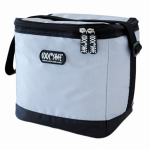
What should I look for when comparing and choosing medication cooler bags?

What should I look for when comparing and choosing medication cooler bags?
Many people assume that a medication cooler bag is automatically safe. But that’s exactly where the problems begin. Read on to find out how you can check a cooler bag yourself to ensure it’s safe.
These four misleading assumptions are particularly common—and particularly risky:
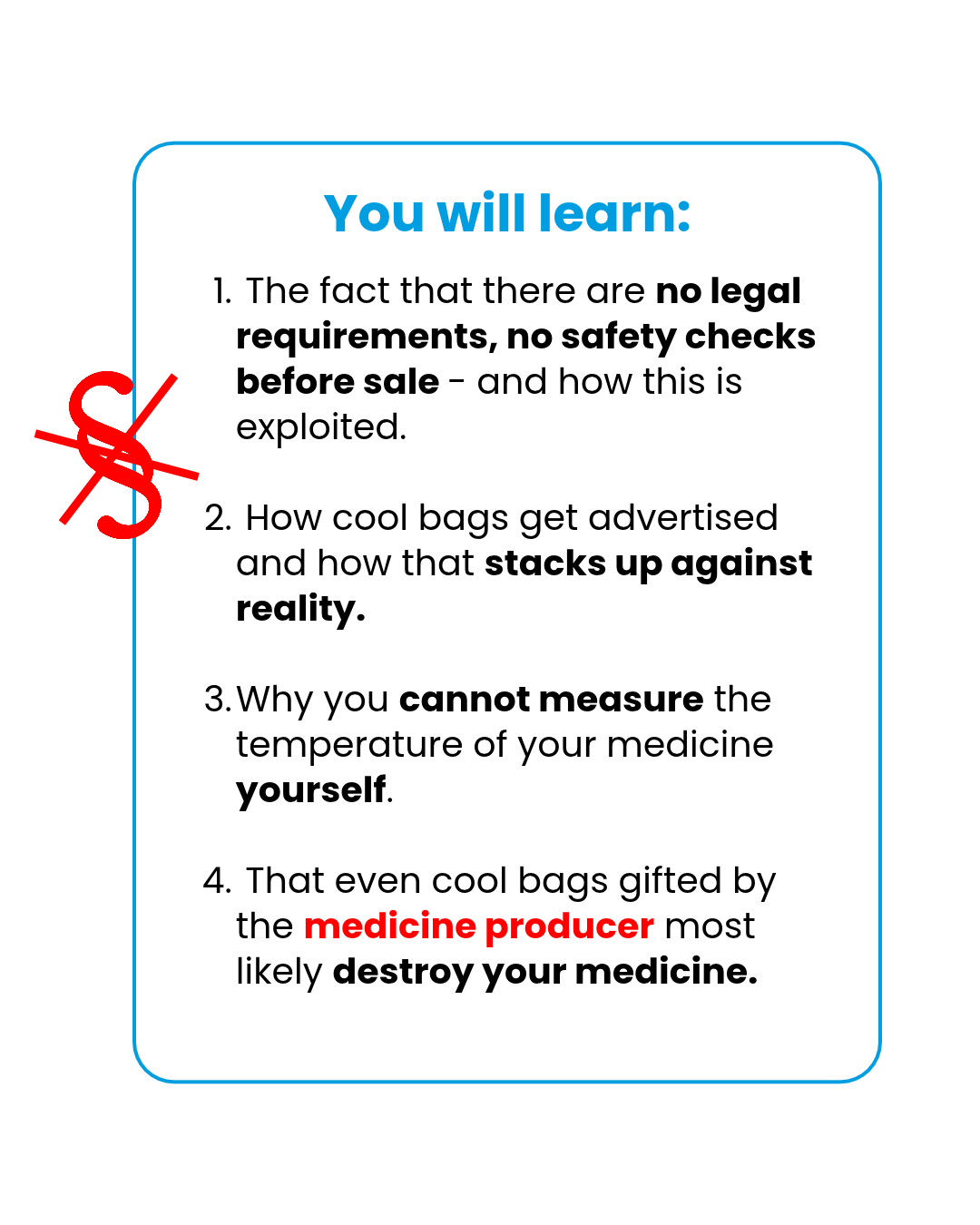
Did you know that cooler bags are not legally classified as medical devices?
There is no DIN standard, nor is there any government-mandated testing of cooling performance.
Many people believe that medication cooler bags are subject to strict legal testing. In fact, this market is largely not as regulated as many expect. There are no approval procedures, and no quality controls by authorities. CE marks may not even be put on cool bags – UNLESS they are electrical. Once you see a bag advertised with “CE” or “TSA approved” you can already know that the sellers do not know what they are talking about.
Generally said: There is no requirement to provide genuine proof of the cooling performance of medicine cool bags: neither of the cooling duration nor if the medicine falls below +2 °C/36 °F. The existing guidelines of the WHO or of GDP practice cannot be applied to small medicine cool bags. In case a seller sends you some test report, you can check if the testing setup was done correctly HERE. Most of the times they are manipulated to make them look nice on paper.
The cooler bag market is a wild west. It’s all show and no substance, whether you buy the cooler bag on Amazon, at a pharmacy, or directly from the manufacturer. Anyone can advertise with claims like “keeps contents cool for 24 hours,” “safe at 2–8 °C,” or “ideal for insulin and biologics,” etc., even if they aren’t true.
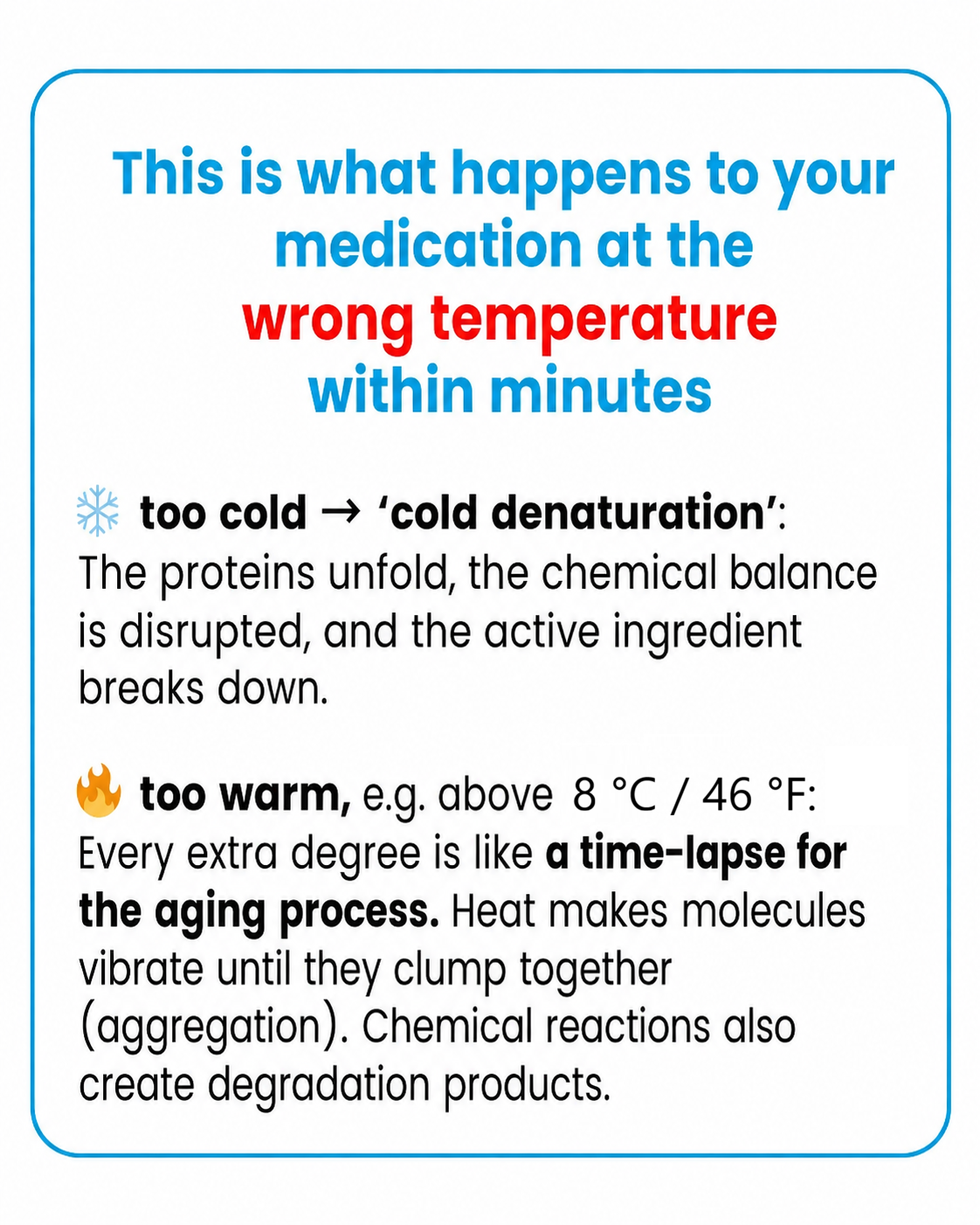
If your medication is stored at the wrong temperature for even a few minutes, it will negatively affect its shelf life, safety, and effectiveness. The damage is not visible to the naked eye and cannot be reversed—even if the medication is subsequently returned to the refrigerator and stored at the correct temperature after being improperly stored or transported. Once damaged, it is permanently damaged.
What are the effects on your health? The medication no longer works as it should. It may even cause side effects.
Since a medicine cooling bag is officially not classified as a medical device, general advertising law applies.
This means that claims such as:
may be made without standardized, independently verified, real-world evidence to prove them.
These claims are usually further supported by graphics showing temperature curves — or simply by a static image displaying the ideal temperature range. At first glance, these graphics, temperature curves and claims can look very convincing. However, they are not automatically proof of real safety.
What matters is not how professional a graphic looks, but how and where the temperature was actually measured.
Example of a typical static image:
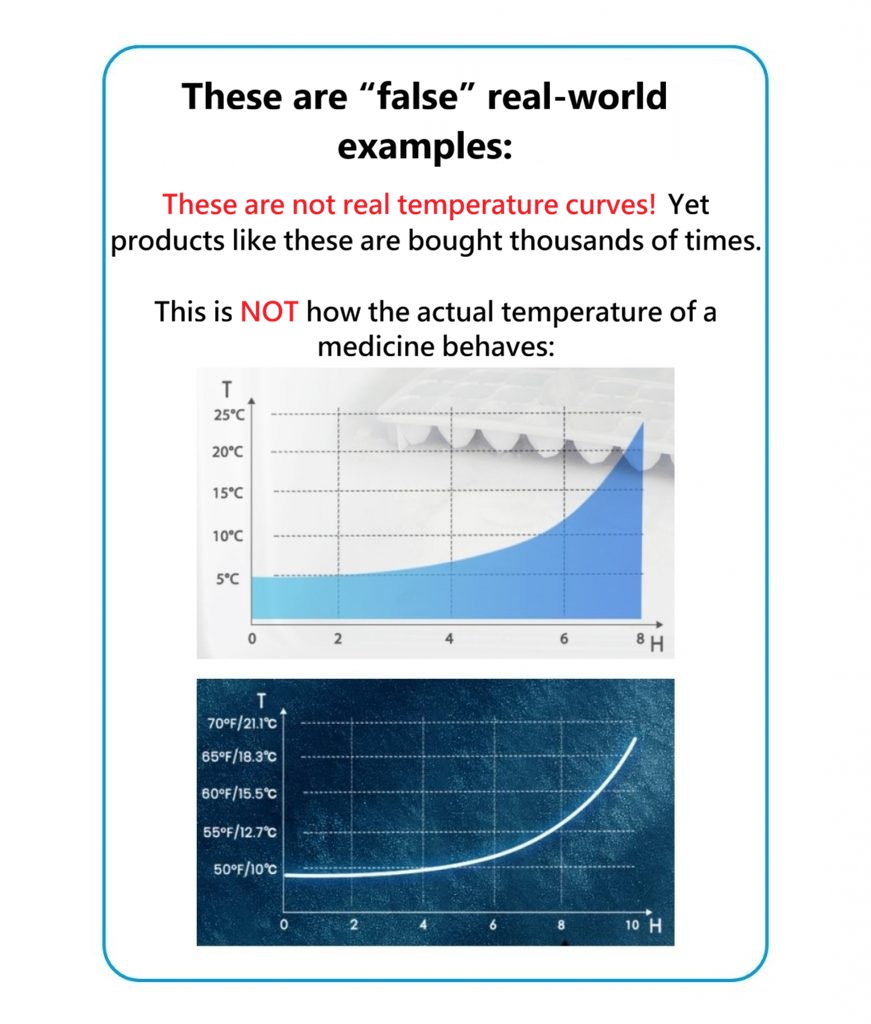
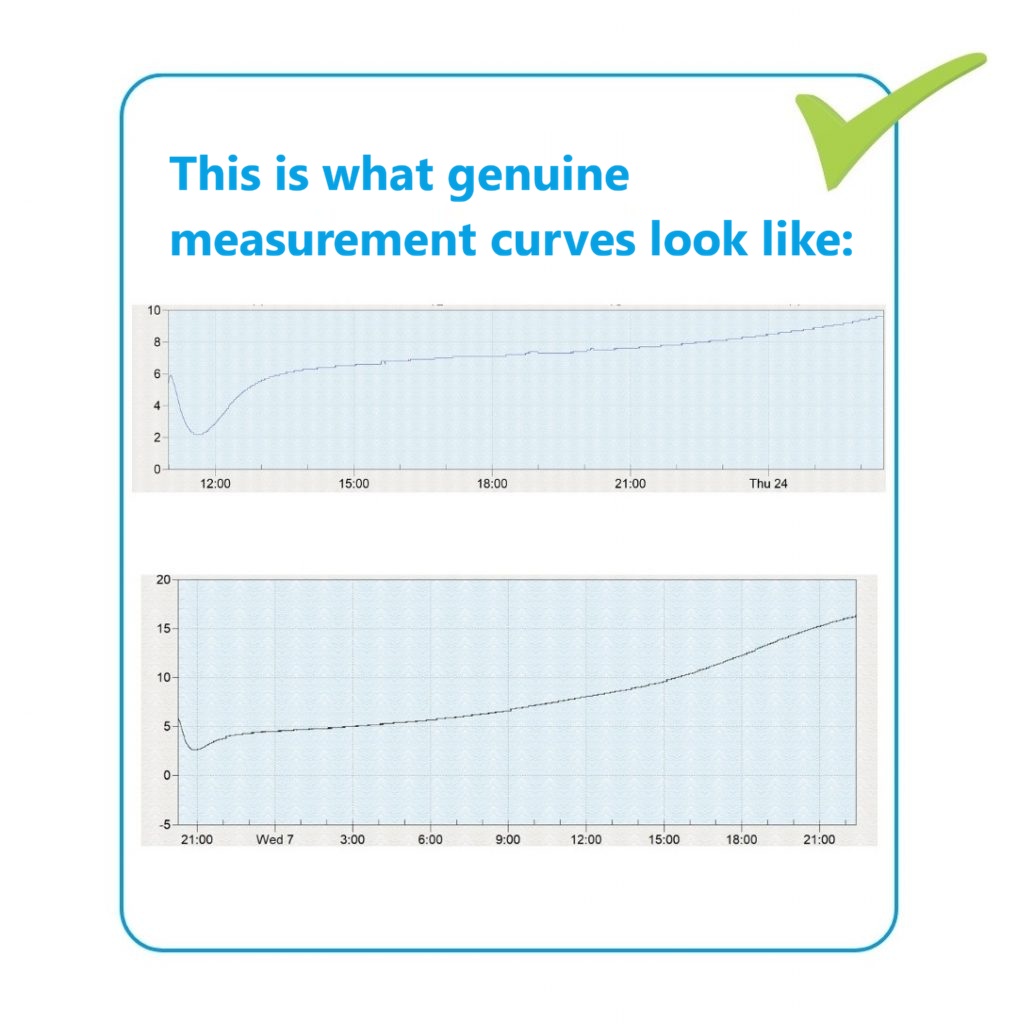
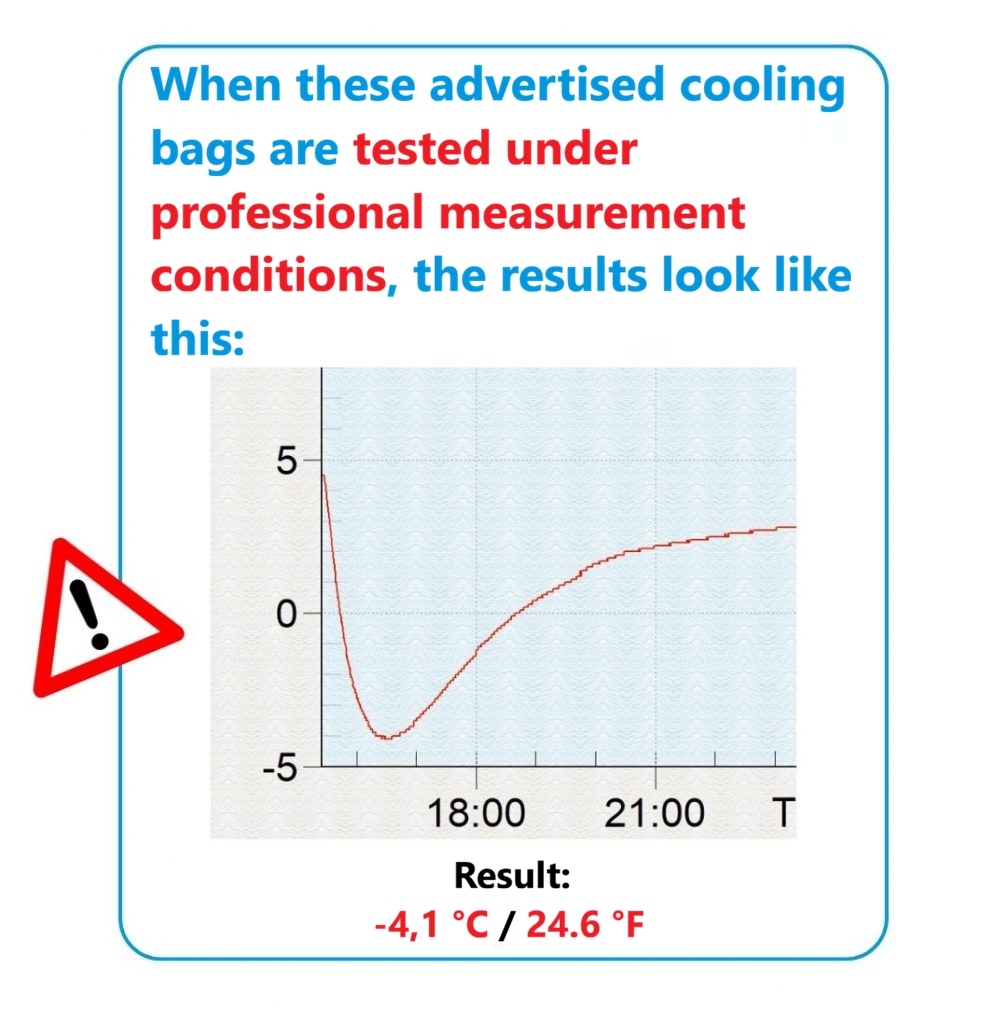
Even test reports for cooling bags like these can be structured in a way that makes them look safe on paper — while, in real-world use, they may still put the medicine at risk.
Here, you will learn which methods can be used to create this impression and how you can check a test report yourself to assess whether it truly indicates safety.

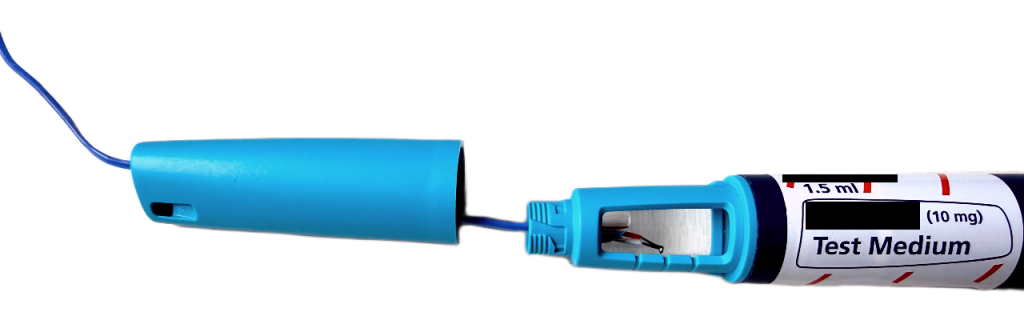
The wish to measure the temperature yourself is completely understandable. However, external thermometers or data loggers only measure the air inside the bag — not the actual temperature inside the medicine.
It is like measuring a fever outside the body. That is the crucial difference.
Air temperature is not medicine temperature.
Precise statements about the temperature inside the medicine are only possible when the measurement is taken directly inside it. The difference between the surrounding air and the actual medicine temperature can be several degrees.
Many people trust that a cooling bag provided together with their medicine must automatically be especially safe. Unfortunately, this is not necessarily the case.
Here, too, commonly available bags may be used — the same types of products found in what is still largely a “Wild West” market. And when these bags are selected, in most cases, the selection is primarily driven by keeping costs as low as possible..
Just because a cooling bag is handed out together with a medicine does not automatically mean it is a demonstrably safe solution.
For many people who rely on temperature-sensitive medicines, the market for medicine cooling bags is difficult to navigate. Big promises, strong visuals and convincing wording can create trust — even when solid evidence is missing. That is exactly why education is so important.
What you should really look for when comparing and choosing a medicine cooling bag:
When safety matters, evidence should be a given.
COOL*SAFE was developed to close exactly this gap: with transparent measurement data, protection against freezing caused by cold packs, and a construction engineered for the safety of temperature-sensitive medicines — not merely for marketing effect.